June 2006 Archives

MindBody0606.jpg

Who or what is in
control of your life?

By Chris Lucerne, PCC

Success means different things to different people. Traditionally, success has been viewed through the lens of accomplishment, acquisition and lifestyle. In other words, we know we are successful by how much money we have and what we achieve in our business and personal lives. We define success by what we have acquired, such as our homes, vehicles and a host of trinkets and toys. We define success by the lifestyle we have created, which includes such things such as travel, pleasure and health. Because this has been our definition, becoming successful has a tendency to be "goal related" and, in that, success can often be seen as something to be found off in the future and to be very dependent on external circumstances and other people. It also can be fleeting; for once we have achieved success, we set a new goal, and the carrot is once again put in front of us. So experiencing an ongoing feeling of success can be difficult if not impossible.

What if we approached defining success in a different way, a way in which we could experience it right now and have it all of the time? Here is a method to do just that! Fill in the blanks of the following sentence:
"I know I am being successful by how ___________ (quantity or quality, i.e. how much, how often, how easily, how completely) I _____________."

Example: In your professional life, being well prepared and mentally clear might be very important to you. Consequently, your "Successful Now" statement would read, "I know I am being successful by how often I am well prepared and have sharp mental clarity." While this statement may seem shallow, it actually will require a great deal from you. In order to experience this definition of success, the following is likely to be involved.

Being well prepared requires thoroughly thinking through and finishing all tasks related to whatever you've committed. It requires connecting with more than your intellectual mind. You must also connect with your intuition and emotions, and you must allow your whole self to be prepared. It requires being ready, well in advance, so that you have a reserve of time and are not rushing into situations.
Sharp mental clarity involves extreme self-care, including exercise, so that you have plenty of energy. It requires eating healthful foods, drinking lots of water, breathing correctly, getting plenty of relaxation and sleep and regularly meditating so that you feel connected.

While in life you will still work toward goals related to achievement, acquisition and lifestyle, being successful now definitely makes goal achievement an easier and much more satisfying journey.

You have the choice of how you define success. You can simply adopt someone else's definition, or you can take the time to create your own. I highly recommend that you do the latter. If you choose to use the "successful now" method, here are the steps you will take:

Come up with at least three (and no more than seven) statements about how you know you are being successful right now. For example: I know I am being successful by how _________ (quantity or quality, i.e. how much, how often, how easily, how completely) I _________.
What do you do, or what ways of being do you have that define your success? Consider the following aspects of your life. Who, or how, are you in . . .

• your relationships with family, friends, business associates, community, and your relationship with yourself?
• your work or career?
• caring for your physical, mental, emotional and spiritual well-being?
• your fun and leisure time?
• your community contribution or volunteer work?
• the way you care for your physical environment (home, work, vehicle)?
• handling your finances?

To be Successful NOW, your statement must:
• be attainable now or at least be very quickly attainable
• not be contingent on external factors
• not be dependent on other people
• be completely within your control
• bring a sense of peace and joy.

Defining success in this way will give you many benefits, such as:
• the power to feel successful on an on-going basis
• building your own self-efficacy (self-esteem, self-care, and more fully trusting and loving toward yourself)
• having integrity within yourself
• personalizing and empowering your values, which leads to happiness
• support in more easily achieving your goals.

I encourage you to experiment with this style of defining success. You have nothing to loose, and you just might find yourself quite frequently feeling successful, if not every day. Using this definition can be a profound way of loving yourself.

NOTE: This article was inspired by the late Thomas Leonard, who was known as the founder of coaching. Thank you, Thomas, for your brilliance and your vision. We miss your inspiring presence.

Chris Lucerne is a professional, certified coach. Using a body-mind centered approach, she specializes in two areas: supporting clients to build relationships that matter, and to go beyond loss and embrace life.
Visit her Web site atwww.ChrisLucerne.com or call her (210) 408-7699.

Going for the Gold

| No Comments
Stride0606.jpgThe Case for pin-on
medals and awards


By Paul Baltutis

I found my topic for my article this month by doing a little "people watching" during Fiesta week. While I was walking around during the King William Fair and checking out the robust activity on the streets, I couldn't help but notice the popularity of colorful, pin-on, chest medals worn by many a Fiesta reveler. There were quite a range of people who were adorned with these medals; there were individuals with as few as one medal, some who wore a spattering of several medals, and some whose entire chest was covered by medals.

These medals were clearly a part of their "costumes" along with sashes, tiaras, crowns, or just about any other kind of "get-up" under the sun. It is pretty clear that the medals are worn simply for fun and are purely decorative; they're obviously not earned by having achieved any real accomplishment, but I still couldn't help but be impressed with their effect.

Such impressions all go back to the history of awards. The recognition of heroism is a very old tradition. The Greeks awarded crowns, and the ancient Romans awarded torques and decorative disks. The Romans also recognized the most meritorious people in their fields with a wreath made from branches of laurel. The Romans awarded wreaths not only to brave soldiers, but also to those who won a race or made a great speech. Somewhere during the Middle Ages, military commanders started presenting medals, attached to colorful ribbons, to deserving individuals.

The symbol that a medal represents, as we all learned from the Wizard of Oz, clearly distinguishes a person and validates acts of courage. Did you not notice the pride in the Cowardly Lion's face when the Wizard of Oz gave him a medal for courage? It is no wonder that medals are a festive part of any Fiesta costume, for they make people feel good about themselves.

So what does any of this talk of medals have to do with running? Recently I have been doing some research about marathon runners during the turn of the century, circa 1896-1908. I was struck by how many runners were photographed with medals on their chests. They just didn't hand out neck medallions during that era; each and every runner I saw in the photographs wore his or her medals.

As seen during Fiesta, some runners had one medal, some had a few medals, and some, like Hamilton Gray, as pictured, had a chest full of them. Wearing them, I observed, seemed to be a source of pride. It also showed everyone where the athletes were in the pecking order of things. The more medals a runner had, the bigger his reputation.

Athletic pin-on medals are quite rare these days, for they have been "phased out" in favor of medals given with ribbons to be worn around the neck. Not that there is anything wrong with neck medals, but they are harder to show off. As we all know, most neck medals get stored away only to collect dust. Add to that the fact that the trend for medals at marathons now seems to be "bigger is better." Has anyone every seen the Little Rock Marathon medal? It is so huge it would probably bruise your sternum if you actually wore it! A smaller medal pinned to your shirt -- now that is something you can build on.

I think we need to change two things when it comes to awarding race medals for participation and performance; First, let's "down size" the medals, and second, let's pin them on. I hope a San Antonio-area race director will adopt this idea and offer a race with pin-on award.
If this idea becomes popular again and races start awarding pin-on medals, what better place would there be to show off your awards than on your outfit during Fiesta Week? Now, go out and start training because we all have a long way to catch-up with Hamilton Gray.
 
Paul Baltutis is the manager of Soler's Sports in Alamo Heights. He is a certified Marathon Coach for Team in Training. He can be reached at sage_run03@yahoo.com or call Soler's Sports (210) 930-3148.

Cycling Without Back Pain

| No Comments
Health0606.jpgExercise, Stretches &
Preventative Care can help.


by Annette M. Zaharoff M.D.

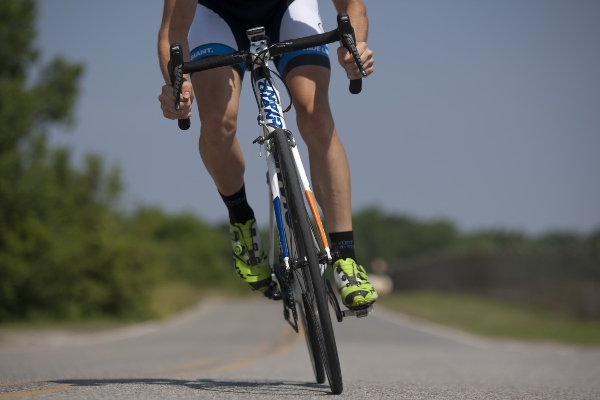
Cycling is an extremely popular sport, with millions of people riding for recreation, competition and exercise activity. Physicians often recommend stationary cycling in rehabilitation programs to avoid some of the impact movements of other sports and activities. Unfortunately, a variety of injuries can occur with cycling. One of the most common areas for pain to develop is in the lower back. It is reported that 80 percent of cyclists will suffer with low back pain. The good news is that approximately 95 percent of these problems can be resolved with preventative care, exercises and stretches.

The Role of the Back
The back has several key roles in supporting the cyclist:

Improves pedaling: The back prevents the pelvis from rocking or tilting, which makes the leg muscles work more efficiently.

Helps breathing: A supportive spine opens up the chest and makes respiration easier which may cause less cramping of the diaphragm.

Improves aerodynamics: The back supports your forward riding position, cutting down on wind resistance.

Why does the back get stressed in cycling? One way is the nature of the spine's position while you ride; It practically suspends your upper body in space for hours while you ride. Besides that, pushing big gears, riding off road on pounding surfaces and riding a bike that doesn't fit can all contribute to your torturing your back.

Avoiding Strain
How do you avoid overusing the back during your rides? First, gradually accustom your lower back to increased riding. If you develop a backache, limit your mileage increase to 10 percent per week, or drop by 10 percent per week, until the pain resolves.

Next, ride in the smaller gears with less resistance. The larger gears require more exertion by the buttock muscles, which in turn will gradually involve more fatigue to the lower back muscles. The muscles in the lower back are not built to withstand such prolonged stress and will fatigue. Avoid riding hills everyday to reduce the stress to the lower back muscles. Hills affect the back similar to pushing big gears.

If you use aero-bars, take a break from them once in a while. This riding position causes more flexion and stress on the spine. More road shock is also transmitted to the spine in this position.

Remember to stretch on and off the bike to keep the muscles loose and warmed up. Stretching increases blood and nutrients to the discs and surrounding areas and helps "lubricate" the small joints of the spine.

Other things you can do to prevent strain to the lower back:
• Alternate between pavement and off road. Too much pounding from rough ground may injure the back. If you ride off road, rising off the saddle for bumps and using the arms and legs as shock absorbers will help.
• Make sure your bike fits you. Nothing is worse than ill-fitting equipment. Imagine running in a tight pair of shoes! A misfit on your bike can torture your spine.
• Be careful lifting your bike. Carry your bike close, and bend at the knees when lifting it. Repeated bending and twisting of the lower back while lifting can lead to injury of the discs until one more twist causes the disc to rupture.

Back Support
The best way to support your back is by keeping your abdominal muscles strong. "Crunches" will do the trick. Lie flat on your back with your knees bent, feet flat on the floor, unanchored. With your arms across your chest or behind the back of your head, curl your head and shoulders up just enough to clear you shoulder blades from the floor. Try to keep your head in line with your shoulders. You will feel the stomach muscles tighten. Build up to 100 repetitions, and repeat four to five times per week.

Remember, your back helps harness the power of your legs in cycling. Keep it healthy and strong to maintain a good pedaling partner. If you do experience lower back pain, consult your sports medicine physician for advice. There are many excellent non-operative treatments available to take care of your cycling backache!

Dr. Annette Zaharoff is a sports medicine physician specializing in the non-surgical evaluation and treatment of injuries. She maintains a private practice in San Antonio and may reached by calling her office at (210) 616-0646 or visiting her Web site www.drZmd.com.

The "Ab"-solute Ab Workout

| No Comments
Fitness0606.jpg

It's time to get
your abs in shape!

By Shannon Sutton

Been looking for your abs?
Haven't seen them in quite some time? Maybe not since high school athletics? Holding on to your "skinny clothes" in hopes that one day they will once again miraculously fit?

Well, it's time to make it happen!

As we have mentioned before, the key to great overall fitness is comprised of a few equally important factors: a well-balanced nutritional program spread out into five to six, smaller, more frequent "meals," a consistent cardiovascular routine with plenty of variety and, of course, resistance training.

Consistency is so very important in the formula! Every little thing you do contributes to calorie expenditure. Park a little further away, use the stairs instead of the elevator, walk the dog and play with the kids.
It all helps!

Let's uncover those long-lost abs. Ab exercises can be done almost anywhere, anytime. No more excuses! Are you sitting down while reading this? Without moving, take a good look at your posture. Are you slouched over? Are your shoulders slumped forward? Is your gut hanging out? Our first ab "exercise" begins right now!

Sit up straight, pull your shoulders back and abs in. Holding your "core" or midsection in is an exercise all in itself! Practicing good posture when you're sitting, driving, walking, washing dishes, working on the computer, and so on, all pays off over time. Replacing your desk chair with a stability ball really keeps you aware of your posture and helps tighten the abs and obliques.

There are countless exercises and contraptions for training the abdominals. It is good to mix and match. The following are a few of my favorites. Remember that precise form and slow, controlled movements are generally the key to a great abdominal workout.

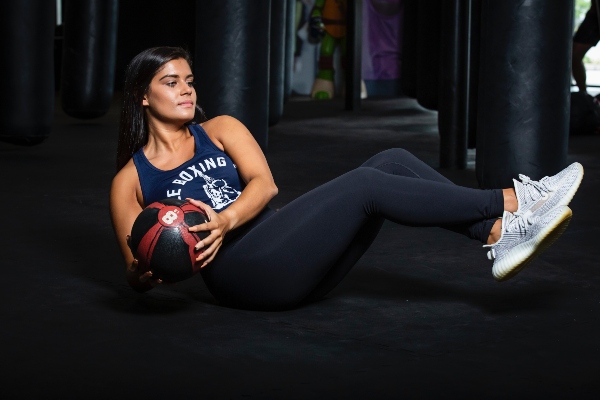
Hip thrust: Lie on your back with palms face down by your sides for balance. Press your lower back to the floor, pull your navel in, and raise legs up over the hips (perpendicular to floor). With flexed heels, raise your hips and glutes slowly, and return to starting position. [Note: Though this is called a "hip thrust," there are no "jerky" movements, and we do not use momentum; it's all about abdominal control].

Straight leg / 90 degree crunch: Begin on your back with legs either straight up from your hips or with knees bent 90 degrees. Press lower back to the floor, support neck with cupped hands, inhale and slowly begin to exhale as you curl your upper body as high as you can (without dropping your chin to your chest) hold for a count, and slowly lower back to starting position.

Reverse crunch: While still lying on your back, palms down by your side, bring your legs up to 90 degrees. Again, press your lower back down, pull in your navel and curl your hips and glutes toward your ribs. Slowly lower your legs back down, and extend the legs out slightly toward floor (without losing contact between lower back and floor).

Crossover crunch/ bicycle crunch: Lie on your back with one foot planted and the other ankle crossed over the knee. While supporting your neck with cupped hands, inhale and press the lower back down, and exhale as you slowly begin to crunch as high as you can, pulling your ribcage toward your hipbone; hold for a count, and slowly lower back down. Be sure to keep your chin up. Switch sides once reps have been completed. This exercise may also be performed by crossing over with the feet slightly elevated, alternating the extended leg with the opposite shoulder. Be sure to squeeze your obliques while performing these exercises.

To increase the degree of difficulty, the exercises can be performed at an incline or with ankle weights. You may choose to perform the exercises as a series, with no rest between sets or implement them throughout your workout while you are "resting" other body parts. I recommend working your abs at least three times a week and varying the type of exercises that you do. Be sure to work your lower back as well! Good luck and train hard!

Shannon Sutton is an independent Certified Personal Trainer. Her certifications include ISSA, NASM, APEX and Reebok. She has helped individuals in the San Antonio area reach their health, fitness and wellness goals for many years.
Contact her at (210) 722-3962. You may e-mail Ms. Sutton at jssutton2003@yahoo.com.

Total Immersion

| No Comments
Feature0606.jpg

SA Swimmer Josh Davis
Focuses on 2008 Olympics

By Kelly A. Goff

It seems that so many of the Olympic hopefuls you hear about these days are the teens and twenty-somethings that alternate grueling workouts and international competitions with wild nights out. With youth and deep-pocket sponsors on their side, they can focus on their sport to all exclusion as they set their sights on the medal stand.

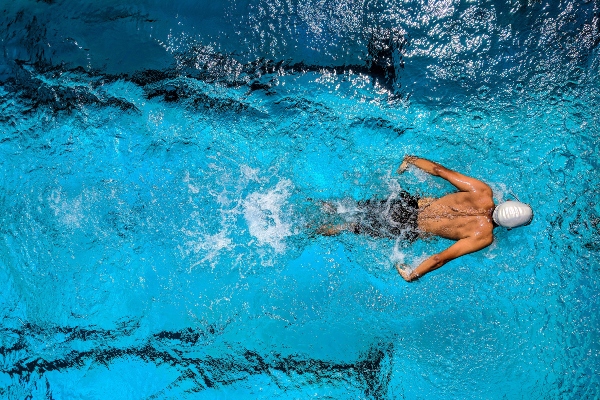
At 33 years old, Olympic swimmer and San Antonio native Josh Davis doesn't fit that mold. The father of five children, a motivational speaker and master swimming clinician, hasn't competed in the Olympics since 2000. A triple gold medalist in the 1996 Olympics and a two-time silver medalist in the 2000 games, one might think Davis has closed that chapter of his life. After all, he and his wife run the largest and most successful swim clinic business in the nation, he continues to champion literacy and academic achievement through his Olympic reading awards program and he's an active father of five young children. It's a full life by any measure, but Davis' competitive spirit refuses to be put to bed. He's diving back into international competition with a bid for the 2008 summer Olympics in Beijing, China.

Why another quest for gold?
"I can do this!" said the little voice in the back of his head - the one that has whispered quiet words of courage and motivation throughout his life. The little voice went from a whisper to a roar ever since he didn't make the 2004 Olympic team. "I didn't train as well as I hoped for Athens and missed making the team by a few tenths of second," said Davis. "I only spent about five months training because I was working hard on building a literacy awards program in San Antonio." He spoke to nearly 10,000 school children that year and is proud of his efforts to encourage San Antonio's youth to read more. He has no regrets about trading swim practice for helping kids. "It's so rewarding being out in the community, and it was important to me to develop as a speaker and business person," reflects Davis. "But now I'm at a place in my life where things are getting a little easier - the kids are sleeping through the night, my wife isn't pregnant, I'm able to pick and choose my speaking engagements - it just seems like a good time to do this."

And do it he will. He's so serious about going to Beijing that he and his family are moving to the mountains high above Mexico City this summer so he can train at a high altitude at a specialized training facility. For the next two years he'll train four to six hours a day, working the circuit of swimming, weights and rest to attain a competitive edge that will be realized on a cellular level.

"If you're trying to win medals, you become a bit of a robot," he says of Olympic training. "You don't have to be completely one dimensional, but it is a full-time job where it's all about you. You have to train right, sleep right, eat right. It's a very selfish lifestyle, and I'm fortunate that my wife is willing to help and support me. I couldn't have won those other medals without her. We're a team."

Continual coach
Although being an elite athlete may necessitate a self-focused regimen, Josh Davis is anything but selfish. He credits the world-class coaches he's had throughout the years for his ability to continuously focus and achieve. It's one of the reasons he coaches and speaks professionally. Helping others be the best they can be, whether it's athletically, academically or spiritually, is an essential ingredient in Davis' character. In fact he's turning his coaching philosophies and advice into a book that's something akin to "Seven Gold Medal Habits" for athletes looking to achieve balance before burnout.

"There are essential facets of each person that need attention," says Davis. "From finesse to fitness, flexibility and fueling to focus, family and fun, it's all about balance." The wisdom he's acquired over the years isn't just applicable to Olympians. For instance, families are so busy these days that often, personal fitness goes to the bottom of the priority list. "My wife and I talk about this all the time because she was a competitive volleyball player in college and is also accustomed to working out four hours a day," shares Davis. "We've struggled with this all or nothing attitude and finally realized that, even if we can only squeeze in 30 minutes of exercise into a day, it's better than nothing at all."

Swimmer's Secrets
What other bits of fitness wisdom can our local Olympian share? Davis leans in and whispers, "Don't tell my young competitors this, but my cross-training secret is lifting my one-year-old while vacuuming," he laughs. Of course he highly recommends swimming as the perfect total body workout, for it's easy on the joints and works your muscles and cardiovascular system. He's a devotee of Susan Ingraham's masters classes. (Visit the Alamo Area Aquatic Association for class times and locations at www.aaaa-sa.org/Masters.htm). "Joining a masters team is a great way to become a better swimmer and get a good workout," he advises.

Davis is also a big fan of the Olympic lift for strength training. "Get a personal trainer to teach you the proper technique: that's essential to getting any benefit from this move and avoiding injury," he cautions. "I love it because I can build so much strength in half the time it would take me to attain on machines. It works a lot of different muscle groups simultaneously - very efficient for those without much time to workout." Davis also has a love/hate relationship with pull-ups and dips. "They hurt the most, but I like the satisfying feeling that comes afterward. I really feel like I've accomplished something."

And in a day when world records seem to be set with the help of performance-enhancing drugs, it's good to know our hometown hero will be fueled by nothing more controversial than a foot-long Subway turkey sandwich.