January 2007 Archives

New Year, New You

| No Comments
nutrition0107.jpgMaking and keeping your
New Year's resolutions


By Fran Werner, CPT

Is losing weight your New Year's resolution ... again? If so, you're not alone. Getting in shape and losing weight are the most common resolutions people make each year. You may start out gung-ho, but within days or weeks, your willpower and motivation sag. And before you know it, you're back sitting in front of the television with a bag of chips in your hand. You can change that this year by making changes you can stick with through the new year and beyond.

Set realistic goals
Most people try to change too much too fast. They decide they're going to completely change everything at once. Do you set goals of losing two pounds per week and exercising every day? Those are probably not realistic. How do you know if a goal is realistic? Look at your past history. Have you been able to achieve these goals before? Start small. For example, for most people, a weight loss goal of a half to one pound per week is realistic. Start with setting a goal of exercise a few days a week, not every day. You can build up as you get better and start seeing success.

Set specific goals
Often times, people set a goal of "lose weight" or "exercise more." While they're good goals, these are not very specific. Focusing on the actions you're going to take helps increase the likelihood of your success. For example, "I will eat 250 calories less per day" or "I will walk 20 minutes Monday through Friday" are more specific and, therefore, more attainable goals. Remember, make them small, realistic behavior changes; you'll be able to stick with them.

Expect setbacks and disruptions
Success rarely moves forward in a straight line. No one is perfect, and often your best-laid plans meet interference. This doesn't mean you've failed or that the goal you've set can't be achieved. Get back on track as soon as possible.

Set short-term goals
Setting a two-month goal or longer allows time to procrastinate before working on the goal, which then becomes an unrealistic one. Set short-term (one- or two-week) goals along the way.

With these suggestions, you can achieve and maintain your New Year's goals to look and feel better.

NOTE: Future columns will address your healthy eating and weight-management questions. If you have questions you'd like answered, please send them to stfh@lifestyleconsulting.com.

Fran Werner is a certified lifestyle and weight management consultant as well as a certified personal trainer specializing in weight management. Fran has helped thousands of individuals achieve and maintain healthy weights and healthy lifestyles. You can contact her at (512) 794-3848 or at fran@lifestyleconsulting.com. She also maintains an interactive Web site, www.lifestyleconsulting.com.

Livestrong, Armstrong

| No Comments
Strides0107.jpgWhether you cycle or run,
it's all good


By Paul Baltutis

There was quite a buzz at the 2006 New York City Marathon when Lance Armstrong finished the race in Central Park in 2:59:36. As a matter of fact, several reporters said there was more commotion when Armstrong finished then when the actual men's winner, Brazilian Marilson Gomes dos Santos finished. New Yorkers weren't the only ones whipped into a frenzy by Lance's performance that day. Many endurance athletes, runners and bicyclists alike were equally absorbed in how he would do. Here is a fictitious conversation between a runner and a cyclist discussing Armstrong's run ...

Cyclist: So, did you hear Lance Armstrong ran the New York City Marathon?

Runner: Yeah, I heard he ran in it like 2:59. That's a decent time. Goes to show you that Lance has finally returned to his roots; he was a runner first, you know.

Cyclist: Dude, don't read too much into that. He just wanted to run to say he finished a marathon. His true passion will always be cycling.

Runner: Yeah, but don't you think it says something about how tough running a marathon is when a seven-time winner of the Tour de France says that the NYC Marathon was the hardest physical thing he has ever done?

Cyclist: Are you off your medications again? The Tour De France is absolutely the toughest race on the planet. Lance just wasn't able to get in enough training for the marathon. His longest run was 16 miles. He did the last 10 miles on guts alone. Come on, the Tour goes over 2,000 miles in three weeks plus at least five mountain stages in the Pyrenees and the Alps!

Runner: It would seem that Lance thought the hills of Central Park were just as formidable as the Alpe d'Huez. He was really struggling the last three miles there toward the finish. He even said, himself, that he bit off more than he could chew.

Cyclist: You guys spend too much time reading running magazines. No way I am going to say that a marathon is tougher than the Tour.

Runner: At least we have time to read magazines. Our long runs are two to three hours, max. How far did you go out the other day for six hours?

Cyclist: I'll grant you that: we do spend a lot of time on the bike. However, if Lance would have spent half the time he spent he spent training for the Tour on training for the Marathon, he could have sprinted at the end.

Runner: Yeah, well sprinting was the last thing on Lance's mind that day. It was weird to see him nearly limping into the finish line. I respect him for his effort. That took a lot of guts.

Cyclist: Yeah, I don't know what we've been arguing about. Both sports are awesome. Hey, maybe Lance's running was supposed to bring both activities closer together.

Runner: Maybe you're right. Maybe we can get along and respect each other's sport.

Cyclist: If a guy like Lance Armstrong says running is cool, then I'm down with that. After all, you know what they say: only Nixon could go to China. By the way, did I ever tell you there are like 10 billion cyclists in China and only like 30 runners?

Runner: Here we go again!

So, thanks to Lance Armstrong, for a brief moment runners and cyclists saw eye to eye. Thank you, Mr. Armstrong, for setting the bar so high for the rest of us. That reminds me: who would win in a high-jump competition between a runner and a cyclist?

Paul Baltutis is the manager of Soler's Sports in Alamo Heights. He is a certified marathon coach for Team in Training.
He can be reached at sage_run03@yahoo.com.

New Goals for the New Year

| No Comments
Health0107.jpgAdopting a healthy lifestyle
begins with motiviation


By Nicole Rogers, MPH, CHES

With the new year comes a flurry of New Year's resolutions to lead a healthier lifestyle. Some people resolve to exercise more, while others focus on weight loss. Whatever your focus, motivation is the key to your success. Understanding what motivates you will make it easier to succeed after your New Year's resolutions are history.

Put yourself first
Remember that starting a new, active, healthier lifestyle is something that you do for yourself. Consider it an investment in yourself, and remind yourself that you will reap the benefits by living longer and enjoying more years of good health.

Make time
One of the reasons that individuals give for not staying with fitness and weight loss programs is that they just don't have the time. Put yourself first, and make time for fitness by giving it a priority in your life. Be candid with yourself and look at how you spend your time. Start by getting up a little earlier each morning or giving up some television or computer time in the evening. It's an easy trade-off for the life-long benefits that come from good health.

Count the benefits of living a healthier lifestyle
Most people benefit tremendously from consistent exercise and from making healthy choices regarding food. Keep these benefits in mind as you continue your efforts toward a healthier lifestyle. You'll have increased energy, increased mental focus, higher self-esteem and reduced stress. You also can lower your risk for heart disease, diabetes and cancer, as well as for other conditions. Also, you'll be able to fit in all the clothes in your closet.

Identify your own personal reasons
Make your fitness goals meaningful. Do you want to be a size eight again? Do you want to look good for your daughter's wedding? Do you want to impress everyone at your high school reunion? Do you want to set a good example for your children? There are as many reasons to adopt a healthy lifestyle as there are people. Spend some time deciding on the reasons that make fitness important to you. Discuss these reasons with your family and write them down. Then put them on the refrigerator so that you can see them regularly.

Do something that you like
It's easier to stay motivated with when fitness is fun, so pursue a healthier lifestyle in ways that appeal to you. If you are a social person, a class setting where you can bring a friend or meet new friends may work for you. If you enjoy music, get a portable cassette or CD player and walk to your favorite tunes. If you enjoy cooking, consider taking cooking classes to learn to prepare tasty meals that are nutritious, too. Look for classes offered through continuing education programs at your local school district or at area grocery stores.

Monitor your progress
If you are part of a more formal fitness program at a gym or weight loss center, be sure you are weighed and measured on a regular basis. If your fitness efforts are occurring in a more informal setting, pay attention to how your clothes fit, to how you feel after walking up those stairs at the office and to how much energy you have at the end of the day. Take a photo of yourself and post it on the refrigerator. Take another in four weeks. The success of seeing your body change, from losing pounds and inches to improving your body mass index, is a great motivator.

Be realistic
Acknowledge that, despite your level of dedication, it's likely that your progress will be interrupted along the way. Travel, illness, workload and other concerns may make it difficult to work out everyday and for you to adhere to a healthful diet. Realize the setbacks are temporary, and get back on track as soon as you can. Don't feel guilty about it, and don't feel that you have failed. Remember that, for most people, temporary setbacks are to be expected.

Stay informed
Stay motivated by incorporating new ideas on exercise and nutrition into your fitness regiment. Turn to South Texas Fitness & Health for the latest fitness information and advice. Go online for tips on exercise and healthy eating. Learn from others and share your successes with them. Also make sure you are well informed about diet programs, such as Atkins, South Beach and others, before beginning them, and be sure to see a doctor before beginning any weight loss program. Remember that diet pills or homeopathic weight loss drugs should be used with caution.

Make a life-long commitment
Change doesn't come overnight, and there's no one diet or type of exercise that brings instant fitness. Also, what works for one person, may not work for another. It may require time to find that works best for you, so resist the temptation to compare yourself to others. Most of us didn't gain those extra pounds overnight, and it is going to take time to develop the fitness and nutritional behaviors that will get them off. Persistence pays, so stay with your plan and realize you are creating a new way of life for yourself.

Reward yourself
Put aside one dollar for every day of the month that you exercise. At the end of the month, treat yourself to a massage or a copy of the book you have wanted to read or take a friend to a movie or play.

Remember that adopting a healthy lifestyle is a life-long commitment. If work or personal situations interfere, recognize them as temporary and motivate yourself to get right back on track.

Nicole Rogers, MPH, CHES, is the executive director of The Health Collaborative. For more information, visit www.healthcollaborative.net.

The Holiday Hangover

| No Comments
fitness0107.jpgWe're talking the flabby kind

By Shannon Sutton, CPT

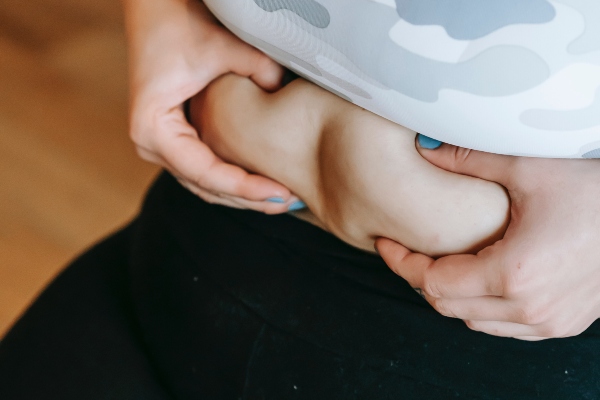
Though you may have recovered from the champagne and eggnog, has the expression "hang over" taken on a new meaning? For many of us, holiday food, family and fun has taken the place of dumbbells, treadmills and crunches. What better time to take care of that "hang over" (the stuff that's hanging over your belt, that is) than the dawning of a new year! The following exercises are targeted to help strengthen the muscles of your torso or core and help flatten and tone your abdominal muscles or abs.

Plank/side plank combo
Begin in push-up position with your shoulders over your wrists and your legs straight-back and parallel. Engage your abs, and focus on pulling your lower ribs away from the floor while keeping them aligned with your hips. Your body should form a straight line from head to heel. Hold this position for a few deep breaths, gradually progressing to 60 seconds. Rest, and stretch if necessary. While still in position, rotate your body to the left and stack your feet. Your right hand and shoulder should be in alignment. Extend your left arm up to form a "T." Hold for 15 to 60 seconds, and return to plank position. Shift your weight to your right hand, rotate to the right and repeat. Focus on keeping your abs engaged, and try not to arch your back. Note: Stop immediately if you begin to experience any lower back pain.

Leg lifts
Lie on your back with palms face down by your hips. SLOWLY raise your hips slightly from the floor, while pulling your navel in. Hold for a count, and slowly lower back to floor. Note: The key is to perform this exercise in a slow, controlled manner. Repeat for 15 to 20 repetitions.

Crunches
While still lying on your back, plant your feet just beyond your "glutes" at hips' width. Press your lower back to the floor while pulling your navel in. With your fingertips behind your ears (or behind your head for neck support), inhale. Exhale as you slowly raise your upper body. Hold for a count, and slowly lower back down. Try not to rest your head and shoulders on the floor in order to maintain the contraction. Repeat. Be sure to keep your chin up (off of your chest) and your elbows back (you're not pulling your head up -- this is for the abdominal muscles). Perform four sets of 25 repetitions. Note: For greater difficulty, raise your feet and bend your knees to 90 degrees.

These are just a few of the countless core or abdominal exercises that should be incorporated into your cardiovascular and resistance training routine along with proper nutrition. Remember that spot reduction unfortunately is not possible, so it is critical to incorporate all elements into your lifestyle in order to beat that holiday "hangover" in time for summer 2007!

It's been said, "If you want something you've never had, you must do something you've never done." These are good words to keep in mind as we face the bright new year ahead.

Shannon Sutton is an independent certified personal trainer. Her certifications include ISSA, NASM, APEX and Reebok. She has invested years in helping individuals reach health, fitness and wellness goals. Contact her at (210) 722-3962.

Focus on Family Fitness

| No Comments
feature0107.jpgThe Scribbick family makes
exercise a daily priority.


By Kelly A. Goff
Photography by Robert French


Aidan, Finn and Sine Scribbick run three miles four to five times a week. They follow that with core abdominal work and stretching, such as flutter kicks and tuck ups on a bar. Weekends usually include at least one four-mile bike ride to the pool, time spent swimming and then a cycling trip home. The two boys, Aidan and Finn, dive two to three hours five days a week after school.

Aidan is 12-years-old, Finn is 10 and their sister Sine (pronounced shi-NAY) is 8.

Future Olympians you say? Perhaps. But that's not the reason for the regimen. For that, one must look to their parents, Frank and Arie Scribbick.

"My philosophy is exercise should be done daily, just like eating and sleeping," says Frank Scribbick, M.D. "If I had to choose between eating, sleeping or exercising on a particular day, I would choose exercise."

Frank's attitude toward exercise developed after he left home for college. His activity level went down, his natural teenage metabolic rate also declined and his weight shot up. "I knew from older, heavier family members that I was at a crossroads," he recalls. "I could change my lifestyle and lose the weight before it got harder, or go down the road of several other relatives and, frankly, most Americans. I chose the former. I changed my major to nutrition science and began exercising daily -- a lifestyle change that has not stopped to this day."

Frank likes to do an hour of low-impact cardiovascular exercise each day, lift weights three times a week and swim four to five times per week.

The children's mother, Arie, (pronounced AHR-ee-ah), is also a physician. Blessed with a quick metabolism, she prefers a more laid-back approach when it comes to her personal fitness. "I used to do a lot of running and tennis. Now I mostly ride horses and run a few times a week," she says.

Active play
The Scribbicks started emphasizing fitness when their children were of preschool age -- not in a regimented way but more through encouraging active play. "When I say 'play' I want them to think of it as a verb," explains Arie. "Like go ride a bike, jump on the trampoline, swim or play football -- it doesn't mean hook up the video game to the TV and sit down." As you may have guessed, the Scribbick household does not harbor any video games, but the family does have a television.

So what's their secret to getting the kids off the couch and moving -- bribery? Some might call it trickery; Frank prefers to think of it as pre-planning. "I often grab the kids and say we're going for a bike ride. Then we end up at the swimming pool where I have conveniently packed their swimsuits." Frank says now they sometimes try and search him for swimsuits before they will get on their bikes. "They usually always whine a bit before going," admits Frank. "But once we're riding down the road or playing in the pool, they're laughing and having fun."

Arie says making fitness a family priority takes parental involvement. "You have to set an example. My parents used to tell me not to smoke while they were chain smoking. Kids see right through that kind of hypocrisy," she advises. As for kids' resisting participating in physical activity (or cleaning the house for that matter), Arie says it's easier to overcome when you're doing the activity with them. "It comes down to the old 'do as I do, not as I say' adage."

The deep end of discipline
You may be wondering how 'active play' turned into three hours of dive practice a day. When Finn was four-years-old, he loved trying flips and jumps into the Alamo Heights swimming pool. His daredevil dips made other parents worry he would get hurt, so Arie and Frank decided to consult a diving instructor. The instructor thought Finn was too young for the sport but agreed to evaluate his skills on a trampoline.

Little did he know Finn had been bouncing away at home on their backyard trampoline. "The coach was very surprised at his flipping ability at that age," Arie laughs.

Aidan got bored watching his younger brother dive and decided to join him. Now the two boys are part of San Antonio Divers team. They train at the Josh Davis Natatorium at Blossom Athletic Center and have been competing nationally for a number of years. This past September the boys traveled to Shanghai, China, to be a part of the national team at the Amateur Athletic Union National competition.

While they do sometimes miss the opportunity to play other sports like football or baseball, both boys enjoy making friends with a common interest from all over the country. Arie says the chance to travel throughout the U.S. and abroad has been good for the entire family.

Although diving isn't mainstream, it is a great sport for developing focus and self-confidence. "It's just you and the board; without focus the results can somehow become painful. And because it's a subjective sport with judging, the children learn there are nuances to what people perceive as 'better,'" observes Arie. "I think these disappointments now can strengthen their personalities for bigger 'judgments' they will face as young adults and adults."

Gift of a lifetime
As physicians, both Arie and Frank deal daily with the devastating effects of obesity. Diabetes and cardiovascular disease wreak havoc on the bodies of millions of Americans, two-thirds of whom are overweight. One-third of U.S. children are also overweight. "The tsunami of childhood obesity has not yet hit the shore -- it takes many years for complications to develop," says obesity researcher David Ludwig of Children's Hospital, Boston. "Imagine heart attack or kidney failure becoming a relatively common condition of young adulthood." Ludwig is a key researcher in a report published in the New England Journal of Medicine that conservatively estimates obesity now reduces average life expectancy by about four to nine months. Additionally, researchers predict that if the current epidemic of child and adolescent obesity continues unabated, life expectancy could be shortened by two to five years in the coming decades.

Frank says the chances of an obese child or young adult actually getting to normal body weight is almost zero. "The sooner children become aware of this the better. We don't have any problem warning them about the dangers of drugs and smoking at an early age, but we give lip service to food choices and physical activity," he says. "We live in a food-toxic environment, while at the same time becoming less and less active. If parents even thought their kids were going to a toxic school or toxic playground, there would be a loud outcry." Couple this with the fact that 'play' for children has taken a turn for the sedentary, and throw in calorie-dense snacks they can munch on while pushing video game buttons, and you have a serious public health problem.

Perhaps part of a growing minority, the Scribbicks are taking their parental responsibilities seriously by reinforcing behavioral changes until they become permanent. For example, when his kids whine about running and say, "Why do we ha ve to run today? We ran yesterday." He replies, "Did you eat yesterday, and do you plan to eat today?"

More than fond memories, the Scribbicks hope their kids develop a lifestyle that seamlessly incorporates fitness, regardless of the activity they chose. Arie likens their emphasis on physical activity to music lessons, "Kids don't like it while they're doing it, but once they become adults, they appreciate having that talent."